Havneholmen 2, 1-3
2450 Copenhagen SV
Denmark
Our industry-standard Essa® equipment ensures reliable and representative sample collection for laboratory analysis, following the fundamental principles laid down in Gy’s Theory of Sampling. Our PERI™ online analysers deliver fast, high-accuracy results for better real-time decision making - from slurry samplers to X-ray fluorescence analysers - across every stream in your copper circuit.
Explore sampling & online analysis
FLS provides the comprehensive means to characterise your ore, test process responses, and control product quality. From initial drying, crushing, and pulverising through to specialised analytical sample preparation and final elemental and mineralogical analysis, in addition to physical determinations such as particle size distributions and metallurgical testing, our scalable solutions have processed hundreds of millions of samples across every major copper-producing region worldwide.
Explore laboratory equipment
Rapid Oxidative Leach® (ROL) is another of our innovations about to rock your world. This mechano-chemical process can leach 97-99% copper directly on site, from concentrates as low as 5% copper in less than six hours.
This makes it feasible for you to produce cathode copper from concentrate directly at the site rather than to sell the concentrate to a smelter. The ROL process can even leach copper from arsenic-laden concentrates.
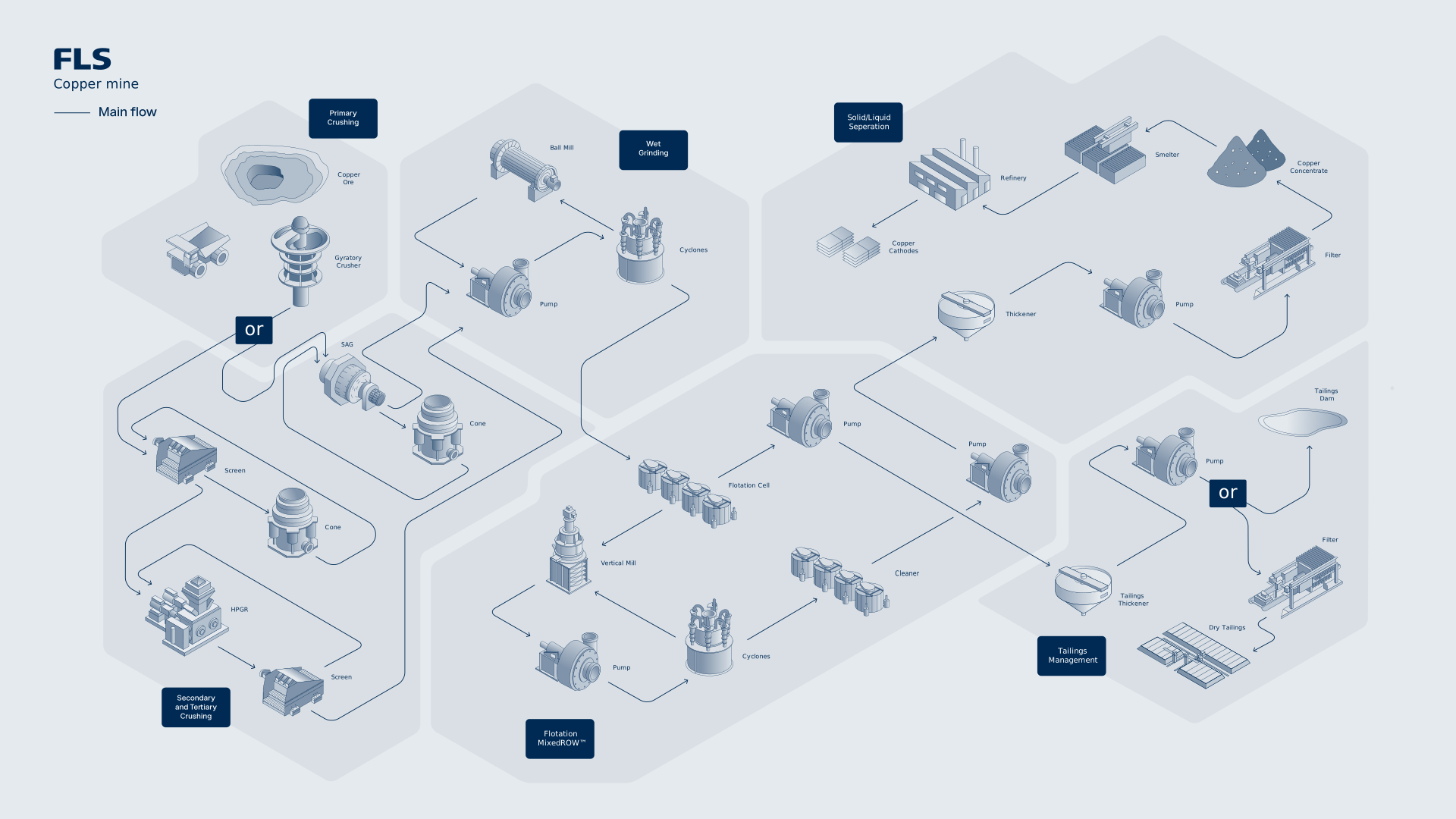
FLS supplies the complete copper flowsheet - technologies engineered to cut energy and water, lift recovery and manage tailings more responsibly. There are benefits in each section, but the greatest value comes from the combined impact of solutions and optimisation across the mine site.
The same circuit serves nickel sulphide, lead and zinc concentrators worldwide. Click any hotspot below to jump to its offering.
Modern copper concentrators chase recovery at increasingly fine grind targets, which drives up the grinding energy bill. coarseAIR™ Flotation Cells capture coarse particles typically lost to tailings - up to 850 µm in sulphide minerals - making a coarser grind feasible and delivering up to 30% energy savings in the grinding circuit. Copper is among the explicitly listed coarseAIR™ applications.
Rougher cells are among the largest power consumers in a copper concentrator. The patented nextSTEP™ rotor/stator is the lowest-operating-power forced-air flotation mechanism on the market, with 15-40% lower power consumption than other mechanisms and up to 5% better recovery. Retrofittable to any forced-air machine regardless of make or model - including brownfield copper concentrators looking to lift performance without replacing cells.
The mixedROW™ flotation system places nextSTEP forced-air cells at the start of the row to recover easy-floating material, with WEMCO® II self-aspirated cells at the end for coarse and fine particle recovery. Patented dart valves transfer slurry between cells with the lowest possible head loss - copper is explicitly listed as a mixedROW application.
FLS PlantVision™ froth cameras use deep neural networks to read froth velocity, bubble size and burst rate in real time, with onboard compute that processes images at the camera. Integrated with advanced process control on the copper rougher banks, PlantVision™ typically lifts mineral recovery by around 2% - ensuring no copper-bearing particle slips past the first stage of flotation.
Where copper-bearing minerals are too coarsely associated with gangue for cleaner flotation to handle, the FLS Tower Mill (FTM) and VXPmill deliver the regrind that liberates them. Energy consumption is reduced by 25% to 50% compared to traditional horizontal ball mills for the same feed and product size, with a simple design that reduces maintenance.
KREBS® gMAX® hydrocyclones provide finer, sharper particle separations at high capacities, so fewer cyclones are needed for the same separation result. The KREBS® OSA onstream particle size analyser then measures particle size distribution in real time, directly in the process stream, so operators adjust the grinding circuit as conditions move instead of waiting on a manual sample and a lab result.
Regrind classification is only as steady as the pumps that feed it, and each position in the circuit wears differently. millMAX™ pumps were developed for abrasive duties and were the first to carry our adjustable wear ring, which stops slurry recirculating and grinding between the impeller and the suction liner. slurryMAX™ pumps cover cyclone feed and tailings on thick, steel-reinforced elastomer linings, with an expeller seal option that takes gland water out of the circuit.
Copper smelters demand a concentrate grade that pays for the freight. Column flotation cells use froth washing to displace gangue from above, producing the high-grade product that downstream smelting economics need. FLS column flotation builds on the original EIMCO Pyramid™ brand with a supply legacy dating back to the 1980s, with high contact at the lowest energy input via an innovative venturi-style sparger system. Modular configure-to-order (CTO) designs reduce CAPEX.
REFLUX™ Flotation Cells (RFC™) operate as a frothless, plug-flow system with air fractions of 45-50% by volume - an order of magnitude greater than conventional open-tank cells. High-shear contacting at the top drives collision and attachment, inclined channels exploit the Boycott effect to send bubbles back up to the overflow, and fluidisation wash water rejects non-floatable material to the underflow. The combination expands the operating window and shifts the grade-recovery curve.
At production scale in a copper concentrator, a single bank of FLS RFC™ cells replaces a row of conventional flotation cells with significant footprint reduction, well over half the air consumption, around 30% lower power draw and a recovery uplift - all at a fraction of the retention time of the conventional circuit.
Copper concentrators rarely sit idle long enough for full circuit replacement. WEMCO® II upgrades existing WEMCO cells with improved kinetics, hydrodynamics and froth stability, while nextSTEP™ retrofits any forced-air machine for the lowest-power mechanism on the market. The nextSTEP Retrofit Kit converts self-aspirated cells to forced-air operation at around 70% less than full replacement - a brownfield throughput lever without the capital outlay.
FLS PERI™ on-stream slurry analysers feed continuous elemental grade data into the cleaner control loop, with measuring times of 15-90 seconds and up to six streams per multiplexer. For copper concentrators running near optimum on the grade-recovery curve, real-time analyser data makes constrained optimisation - maximise feed × recovery subject to grade - practical at site.
Tailings is no longer a back-end disposal problem. It is a permitting issue, a community issue, a water issue and an ESG issue at once. Lower water content in tailings means lower risk, smaller dams and a clearer path to closure. FLS supports the full spectrum, from conventional tailings to high-density, paste and filtered dry-stack, with the equipment and process design experience to make each option work in practice for copper, nickel, lead and zinc operations.
FLS thickeners can be categorised by typical underflow yield stress ranges: high-rate up to about 50 Pa, high-density ranging from 100-150 Pa and the region of 55-65% solids, and deep-cone paste thickeners above 200 Pa at >65% solids. High-rate thickeners deliver around 12 times the throughput of conventional designs - built on FLS's Dorr-Oliver and Eimco heritage that anchors copper concentrator tailings worldwide.
FLS thickeners use E-DUC® self-induced dilution (driven by velocity and geometry) or P-DUC pumped dilution for very high dilution ratios, paired with the E-Volute™ feed well that delivers uniform feed distribution. With an even velocity profile that improves settling rates, lowers flocculant consumption and improves overflow clarity.
The AFP range opens the whole plate stack at once for fast discharge, with cake sizes from AFP900 (900 x 900 mm) to the AFP2500 (2.5 x 2.5 m). Pressure filters typically produce 10-20% moisture cake at up to 10,000 tonnes per day per unit – the throughput copper producers demand.
Long-distance tailings transport means high heads on abrasive slurry. millMAX™-HP pumps carry the standard millMAX hydraulic design into duties above 500 psi (35 bar), with the adjustable wear ring closing the suction side to cut hydraulic recirculation and hold design flow over the life of the pump.
Paste tailings need pumping engineered for it. slurryMAX™-HP pumps take the same wear ring into a split-case design, so the internals open up for inspection and rebuild without disturbing the pipework.
For paste tailings at the upper end of the yield-stress range, a shear-thinning loop returns sheared material from the thickener discharge to the base of the sidewall - making the underflow significantly easier to pump to the tailings storage facility without sacrificing the density that safe storage requires.
FLS Pump, Cyclone and Valve (PCV) Rebuild and Exchange keeps the concentrate-handling circuit running. Worn units ship to FLS service centers for full teardown, rebuild and condition-monitoring report; a swap unit keeps the plant in production. Pre-planned exchanges replace the unplanned shutdowns that hit copper-concentrator economics hardest, with parts staged ahead of shutdowns.
How you manage water has a direct impact on your licence to operate in the copper mining industry. Governments across the world are enforcing new water regulations, and tensions with local communities about the right to use the water can be time consuming and costly.
Together with Goldcorp, we have developed EcoTails™ that blends filtered tailings with waste rock to create a high-density, geotechnically stable product called GeoWaste™. The combination delivers a tailings solution engineered around safety, water recovery and closure economics.
GeoWaste™ makes co-mingled tailings possible even for large scale operations, and even in areas with high seismic activity. The result is a credible alternative to dam-based storage where regulators, communities or geology rule out the conventional option.
Filtered and EcoTails™ enable recirculation of 90 to 95% of your process water, freeing the operation from fresh-water constraints and easing pressure on water-stressed catchments. Less water drawn, less water lost, more value preserved per tonne of copper.
Reducing the water inventory of your tailings facility cuts closure costs and reduces the risk of water contamination, both essential to securing and maintaining your social licence to operate. EcoTails™ can bring an end to tailings dams and thus eliminate the risk of tailings dam failures, while lessening your project's environmental impact.